Reverse-engineering a pseudoscientific explanation for your random word choice part 1.
How do people invent the name for their fantasy series? Or a book? I suspect they have an easier way than I do. Or at least I hope they do.
Pick two glamorous nouns, add Chronicles, and call it a day, aye?
Or, if you do it my way, you pick a name after a rigorous search for availability and credibility, then you create a company named after the picked right word, and then start to play the Devil’s advocate with yourself. So, naturally, I needed to dig deeper and create a pseudo-scientific, logical reason for the said word.
Draugameistari. What does that even mean?
Well, in Old Norse (and luckily in modern Icelandic), it is a combination word of Drauga (genitive plural of the word draugr, which means undead or a ghost) and meistari (master in English). Basically, it means Master of the Dead. But it is not a common hybrid, but it is not grammatically wrong either.
My first choice was the Necromancer, but as you can imagine, that was NOT a unique choice, and I want the name to be unique. Or at least more rare than “The Necromancer Chronicles”.
Draugameistari it is. And I love it. But then I started to question why an ancient Death’s Avatar would be called Draugameistari. Meistari is a loanword from Germanic languages and was in use around the 1200s. Why would the official term be only 800 years old? So for the hunt I went.
Meistari is a derivative from the Latin word magister. In Latin, this title would be Magister Mortis or Magister Mortuorum, or maybe Magisterium Mortis/Magisterium Mortuorum. That does not give me Drauga. It comes from Proto-Germanic, not Latin.
But guess what. Both words (and languages) are in the Proto-Indo-European language family.
So naturally I used my Saturday night going through a 3,000-page etymological dictionary of Proto-Indo-European, using Ctrl+F and spamming both Gemini and ChatGPT with questions (and checking their answers from the said behemoth of the reconstructed historical language) and reconstructing a pseudo-linguistic chain for the word. Instead of actually editing the first book of the series. Time well spent, that is.
A normal Saturday for me. And it just might be the best way to spend a Saturday evening. Do I have a life? Are you kidding? Of course not.
First I traced draugr backwards.
Old Norse draugr goes back to Proto-Germanic *draugaz. F
urther back is the Proto-Indo-European word family usually reconstructed to
*dʰrewgʰ-, meaning deception, harm, falsehood and the like.
But in one of it’s descendant, the Proto-Germanic language family, the words started to mean the undead, a supernatural being, or a ghost.
This made me think. What did the Proto-Indo-European people use to call the undead? The Behemoth could not tell me. But maybe, just maybe, they called the undead false-living?
Avestan apparently has
gaya- = “life” and gaēθā- = “living creature, being, worldly creature.”
It could be realistic to assume
druj-gaēθa- ≈ “false being / creature of the Lie” might have been in use.
Or
druj-gaya- ≈ “false life” / “life belonging to Druj”
Those words when spoken out sound uncannily like draugr.
The second word, magister, is from Latin, but also traces back to Proto-Indo-European.
*méǵh₂isteros - the greater one / superior.
So. Both words of Draugameistari could, independently, be traced back toward Proto-Indo-European; they just took different paths to get back into the same language. So I wanted to create the OG word.
No need to be a real proven word used in PIE. I am writing dark contemporary fantasy, not a thesis in linguistics.
But close enough that someone with the actual knowledge might read it and think, “That’s plausible.”
So I gave it a shot and I ended up with:
*dʰrowgʰo-méǵh₂isteros
Master / Superior of the Phantoms
Master of the Deceivers
The Greater One over the supernatural beings
This is not proven to be an actual Proto-Indo-European word, mind you. This is something I just made up.
There was, however, another problem.
The being called the Draugameistari is actually the Avatar of Death. Not just the commander of the undead.
So Draugameistari should not really be the true OG name. Avatar of Death is also too blah and modern. I want something old and gritty.
There were other gems in that behemoth I found with Ctrl+F.
*mer- / *mṛ-
≈ to die
and
*mṛ-ti-
≈ death
and several other descendants that mean death across several Indo-European languages.
Like this one:
Latin mors, mortis
= death
I went with Mors. It is classy and punchy.
Draugameistari is the title other people gave the to the Avatar of Death a long time ago.
The Necromancer. The Master of Draugr. Kuolleiden Käskijä. Magister Mortis.
Of course a title won’t stay the same as it wanders through time and different countries. It would be renamed, translated, used wrong and get stuck. Replace one half while keeping the other, especially when the two sister languages start to mix again around the 1st century BCE.
Magister Mortuorum -> Drauga-maistar -> Draugameistari
So, the idea now looks roughly like this:
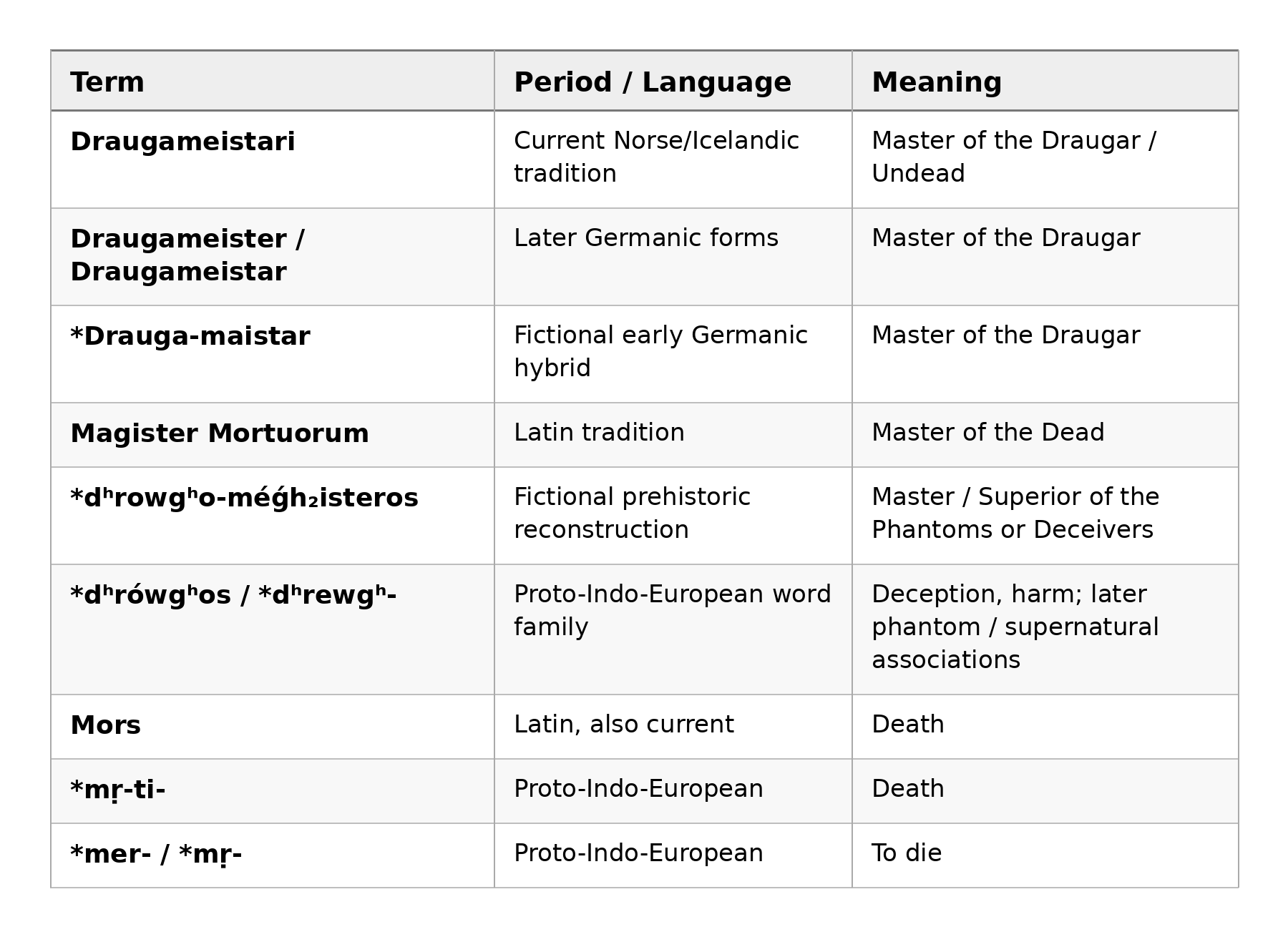
Was any of this necessary?
Actually it was, because otherwise it would have bothered me and I would feel like a fraud. But a regular reader probably does not need an introduction to Proto-Indo-European to understand that this Draugameistari can command the dead.
But someone might ask, some day.
They better be prepared to receive a lesson.


Comments
Post a Comment